How to Play
Everything here assumes you already know the three rules. This is the practical half: what to carry, how a round actually runs, and how to be fast without being a menace.
New to disc golf?
This is the cheap door into the sport. Three discs (a putter, a midrange, a fairway driver), any shoulder bag, and a free public course is a completely legal loadout. There is no disc limit, but you carry every one of them against a clock, so it is a ceiling that sets itself rather than a shopping list.
One honest ask first: play a couple of casual rounds to learn to throw and finish holes. Disco Golf assumes you can complete a course, not that you are any good at it. Slow founding records count forever.
Already play disc golf?
You know 95% of this already. Every rule of disc golf still applies, and the format adds one idea and two clarifications. Fair warning from experience: the first three holes feel strange. Then it feels like freedom.
What to carry
- ◎Discs, and probably fewer than you think No cap, but you carry every one against a running clock, so the cull happens on its own. Going true minimalist is legal too: one disc and empty hands is a fine round, and it has its own chart in the record book.
- ◎A bag, carried however you like Shoulder, backpack, cart, or set down at the tee. Worth knowing: every time the bag comes off you pay twice, once setting it down and once walking back for it. An official Disco Golf bag is in the works.
- ◎Something to run the clock Any stopwatch counts for a casual round. For a record, the Disco.Golf app is the short road: it does the timing, scoring and distance in one, records a GPS track as its own proof, and files the claim the moment you finish. Timing it another way is fine too, but then you need a public link to the round, and you fill the form in by hand.
Your first round, step by step
- Pick a good hour, or just ask. Early mornings and weekday evenings mean open fairways and a faster clock. A busy course is fine too, as long as you handle the group ahead well.
- Sort yourself out at the first tee. Carry what you want, however you want to carry it. If the bag is staying on, settle it now so you never think about it again.
- Get your scorecard ready, then start the clock. Prep is free. The timer must be running before your first throw, so start it as you step to the tee, never after the disc flies.
- If you would rather not think about scoring, don't. Using the app, tap start on the first tee and finish on the last putt, and put the phone away in between. Every hole records at par, and you add the birdies and bogeys afterwards. Two touches the whole round.
- Play disc golf, fast and honest. All PDGA rules apply. No marker needed when you throw the disc you just picked up: stance behind where it lay, and go.
- Stop the clock when the last putt comes to rest. Not at the car. Add your throws to your minutes, and that is your number.
- Say it out loud. You just posted an eighty-one forty-four, or a ninety-six twenty, or a hundred-and-something-proud. Every number is a record somewhere.
Finding your tempo
Speed is never free. Rush and your throws fall apart, and a bad throw costs you the stroke and the walk to go find it. Crawl and the clock eats whatever your accuracy earned you. Somewhere in between is the pace where you score best, and finding it is most of the skill in this sport.
The practical version: walk fast, throw calm. Almost all the time you save is saved between throws, not during them. Sprinting to your disc and then rushing the shot is how a thirty-minute round becomes a thirty-four minute round with six more strokes on it.
If you want a starting pace to run to, the playlist makes that case properly.
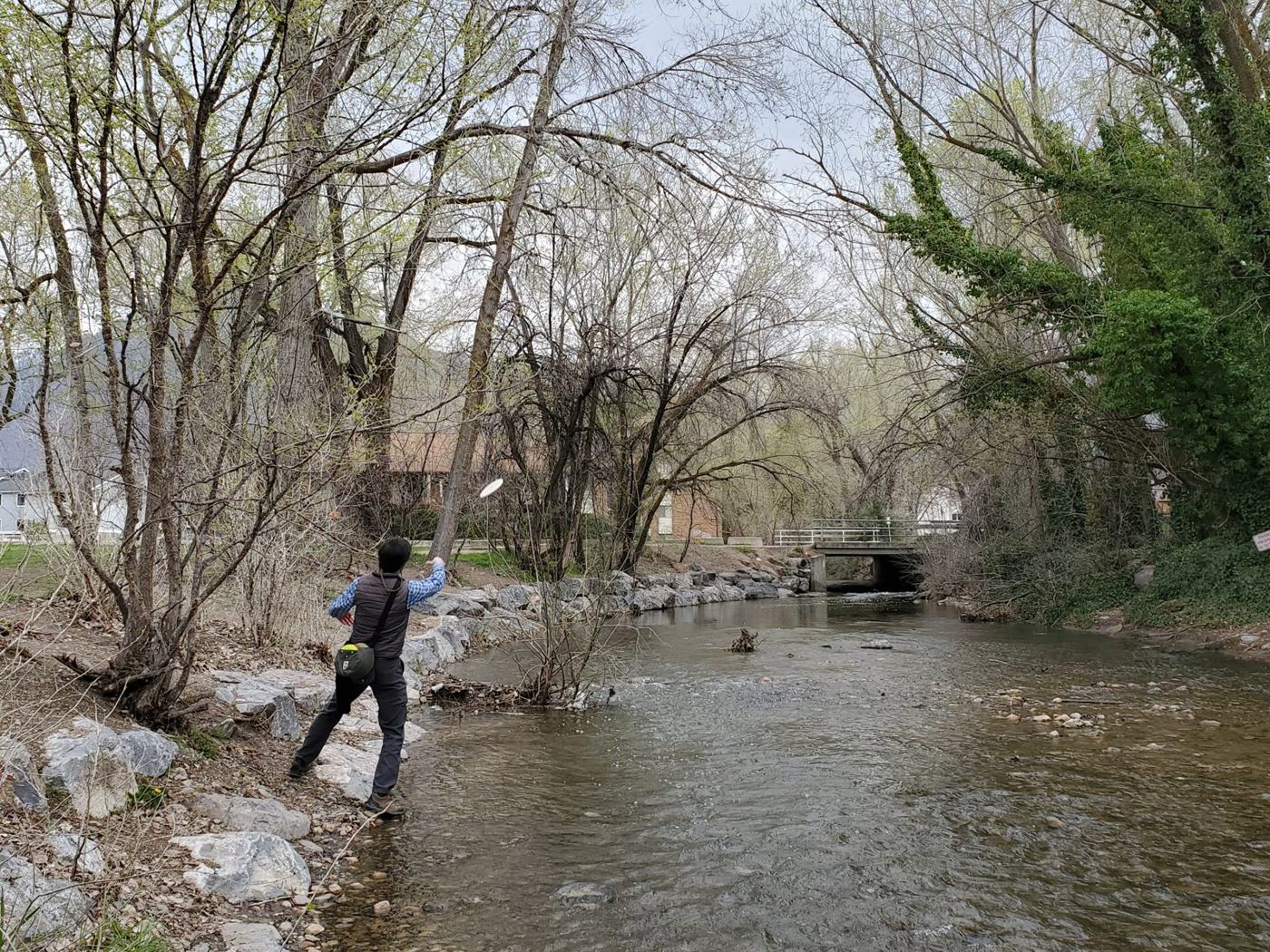
Creek crossing, bag on, clock running
Courtesy, which was never really a rule
This one used to be written down as a rule. It is not one anymore, because it never needed to be: it is simply how you avoid ruining a course for everybody else on it.
You are the fastest thing on that course, and it is not your course. The group ahead has the right of way, always, and you announce yourself before throwing anywhere near anyone. But catch them at their tee and ask nicely: most players can see you are running a fast round and are glad to wave you through, especially once they watch you send a drive past them without breaking stride.
Every friendly play-through is somebody's first look at the sport. Make it a good one.
That is the whole thing. When you finish a round you have a number, and a number is worth something: your home course almost certainly has a founding record nobody has claimed.